Tony Stewart is leaving Joe Gibbs Racing and moving to CNC/Haas. This is big. This is huge. John Hagee will no doubt proclaim this, as he should, a sign of the impending apocalypse. Ray Comfort will do doubt proclaim this, as he should, a sign of God’s wrath being unleashed upon California and/or Atlantic City.
This is like Tom Seaver leaving the Mets. This is like Michael Jordan leaving the Bulls. This is like…
What's that?… I'm sensing that none of you care…
Infidels!
Wednesday, July 09, 2008


Tuesday, July 08, 2008
Now that's just ugly by design
Every day, except when I am in blog-detox (it never works) two of the handful of religion/science ID/evolution sites on my must-see list are Telic Thoughts (TT) and After The Bar Closes (ATBC).
These are, nominally speaking, white-hat black-hat sites. TT is pro-ID (but, at least from Mike Gene, and a couple other contributors, not slavishly so) and Christian friendly. ATBC is anti-ID and populated mostly but not exclusively with atheists.
I like both sites. As a sort of man-without-a-country I get in debates on both, and am (mostly) treated respectfully on both.
I like ATBC in spite of the fact that they have a thread dedicated to my stupidity (Called the Dave Heddle Stat Chat ) that is almost as old if not older than their raison d’être, the thread devoted to the Golden Gate Bridge Painting Task of documenting Uncommon Descent shenanigans. And certainly much older than the one devoted to TT. (And much shorter than either, which is either an insult or a compliment.) I like ATBC because when I post there on theology or fine tuning, and as long as I am on-topic and make actual arguments, they will engage them. Who can ask for more? (On-topic at Uncommon Descent and various ID listserves controlled by WAD or minions thereof simply got me banned.) They are, in fact, much more engaging than Panda's Thumb, from which they were calved. Yes, they are quite irreverent, and definitely not for the faint of heart, but I take guilty pleasure in clever irreverence. Perhaps it is my background—growing up a non-Christian in an inner city environment— I feel quite comfortable in a "Your momma is so ugly…" environment. (And I could be self-righteous and note that being friends of sinners has some precedent, but I wouldn't do that.)
As for TT, I have good relationships with a couple members of the board, am personal friends with someone behind the scenes at TT, and have long considered it the best ID blog. Although I have blogged so long I don't give a rat's butt about links anymore, I appreciate that in spite of my pariah status in the official ID community, TT has maintained its front page link to He Lives.
Lately TT and ATBC have been at war. Actually the war is antisymmetric, comprised of one person named Guts from the TT board of contributors taking on, in a manner of speaking, everyone who cares to join in from the ATBC regulars. The entire inglorious campaign is archived here.
The Sinking of the Maine in this war appears to be something I missed during one of my detox sessions—a banning or barring of an ATBCer named Frostman on TT—with his posts being deleted. That is one of the issues: TT (just like ATBC) has, as I understand, a policy of sending posts that are either off topic or in some other manner "over the top" to a Black Hole of Calcutta thread, the "memory hole" on TT and the "Bathroom Wall" on ATBC. I have personal experience with both. Apparently Frostman's posts were deleted rather than memory-holed.
Not having seen the exchange in question, I have nothing to say about that except this: in the early part of Guts v. ATBC thread, Guts stated he would restore posting privileges if Frostman (the shunned) would apologize to Bradford (another TT contributor) for Frostman's claim (on TT, but, as I understand, deleted) that Bradford took a quote from popular science writer Paul Davies out of context. Guts wrote to Frostman, with emphasis added:
Guts (from the white-hat team, mind you) seems to undergo a rather sudden personality transplant. Civility and reasonableness are cast aside, and he lobs on the order of a hundred small posts at ATBC, hurling insults replete with terms like "asshole, moron, idiot, stupid, dumbass, faggotry, retard" etc. Of these, per se, I have no objection. As I said, I enjoy ATBC in part because of its irreverent style, and I can be as ribald as, say Martin Luther. But when Luther waxed scatological about Rome, he was making a point.
Irreverence without substance is just crass, and that is how Guts behaved. He took a tough stance about how he was willing to debate, and displayed Demsbkian prophetic vision about how he'd repudiate the ATBCers "in the coming weeks," but he posted nothing substantive at all. One ATBCer suggested that Guts was trying to commit suicide by cop. He wanted to be banned from ATBC to deflect criticism that he was a banninator. And the longer he wasn't banned, the more it snowballed. I can't speak to Guts's motives, but the charge smells plausible.
Guts, I'm afraid, and quite sorry to say, made TT look very bad. But here again is the link. Judge for yourself.
These are, nominally speaking, white-hat black-hat sites. TT is pro-ID (but, at least from Mike Gene, and a couple other contributors, not slavishly so) and Christian friendly. ATBC is anti-ID and populated mostly but not exclusively with atheists.
I like both sites. As a sort of man-without-a-country I get in debates on both, and am (mostly) treated respectfully on both.
I like ATBC in spite of the fact that they have a thread dedicated to my stupidity (Called the Dave Heddle Stat Chat ) that is almost as old if not older than their raison d’être, the thread devoted to the Golden Gate Bridge Painting Task of documenting Uncommon Descent shenanigans. And certainly much older than the one devoted to TT. (And much shorter than either, which is either an insult or a compliment.) I like ATBC because when I post there on theology or fine tuning, and as long as I am on-topic and make actual arguments, they will engage them. Who can ask for more? (On-topic at Uncommon Descent and various ID listserves controlled by WAD or minions thereof simply got me banned.) They are, in fact, much more engaging than Panda's Thumb, from which they were calved. Yes, they are quite irreverent, and definitely not for the faint of heart, but I take guilty pleasure in clever irreverence. Perhaps it is my background—growing up a non-Christian in an inner city environment— I feel quite comfortable in a "Your momma is so ugly…" environment. (And I could be self-righteous and note that being friends of sinners has some precedent, but I wouldn't do that.)
As for TT, I have good relationships with a couple members of the board, am personal friends with someone behind the scenes at TT, and have long considered it the best ID blog. Although I have blogged so long I don't give a rat's butt about links anymore, I appreciate that in spite of my pariah status in the official ID community, TT has maintained its front page link to He Lives.
Lately TT and ATBC have been at war. Actually the war is antisymmetric, comprised of one person named Guts from the TT board of contributors taking on, in a manner of speaking, everyone who cares to join in from the ATBC regulars. The entire inglorious campaign is archived here.
The Sinking of the Maine in this war appears to be something I missed during one of my detox sessions—a banning or barring of an ATBCer named Frostman on TT—with his posts being deleted. That is one of the issues: TT (just like ATBC) has, as I understand, a policy of sending posts that are either off topic or in some other manner "over the top" to a Black Hole of Calcutta thread, the "memory hole" on TT and the "Bathroom Wall" on ATBC. I have personal experience with both. Apparently Frostman's posts were deleted rather than memory-holed.
Not having seen the exchange in question, I have nothing to say about that except this: in the early part of Guts v. ATBC thread, Guts stated he would restore posting privileges if Frostman (the shunned) would apologize to Bradford (another TT contributor) for Frostman's claim (on TT, but, as I understand, deleted) that Bradford took a quote from popular science writer Paul Davies out of context. Guts wrote to Frostman, with emphasis added:
For future reference, perhaps understanding that telling someone that they have taken a quote out of context is extremely offensive, and in fact, is not commonplace. It actaully takes a lot of work to selectively choose sentences that would clearly alter the meaning of the paragraph. The Nazis used to do it with various phrases from the Talmud.Letting the Goodwin's Law demonstration slide, Guts is wrong. Telling someone they have taken a quote out of context is not offensive, let alone extremely so, and it is oh-so commonplace as to be darn near ubiquitous. I don't know if Bradford agrees with this, that he was extremely offended, but I hope not. Anyone who finds the accusation of "taking a quote out of context" in the bloghetto that is our ID-evolution online community is much too thin skinned for life in the hood. It is virtually impossible to quote anyone in support of your position (especially anyone nominally assumed to be aligned with the opposition) without a detractor, rightly or wrongly, claiming that you took the quote out of context. I was once, I think it was on Panda's Thumb but I might be wrong, accused of quoting myself out of context.
Guts (from the white-hat team, mind you) seems to undergo a rather sudden personality transplant. Civility and reasonableness are cast aside, and he lobs on the order of a hundred small posts at ATBC, hurling insults replete with terms like "asshole, moron, idiot, stupid, dumbass, faggotry, retard" etc. Of these, per se, I have no objection. As I said, I enjoy ATBC in part because of its irreverent style, and I can be as ribald as, say Martin Luther. But when Luther waxed scatological about Rome, he was making a point.
Irreverence without substance is just crass, and that is how Guts behaved. He took a tough stance about how he was willing to debate, and displayed Demsbkian prophetic vision about how he'd repudiate the ATBCers "in the coming weeks," but he posted nothing substantive at all. One ATBCer suggested that Guts was trying to commit suicide by cop. He wanted to be banned from ATBC to deflect criticism that he was a banninator. And the longer he wasn't banned, the more it snowballed. I can't speak to Guts's motives, but the charge smells plausible.
Guts, I'm afraid, and quite sorry to say, made TT look very bad. But here again is the link. Judge for yourself.
Monday, July 07, 2008
We must be flexible!
A good post about the latest Jesus archaeological blockbuster.
Memo
To: All higher biblical critics
From: The School of Religious Irrelevancy, Hector Avalos, Chairman, Paul Mirecki Secretary, Department of Tenured Cliches, AKA Atheistic Religious Studies Professors.
To those who served our cause well by creating petitions, having funny internet nom de plumes, and writing academic papers that claim that the gospel writers and other redactors added the story of Christ's sufferings, you are hereby asked to cease and desist!
In light of this discovery, the new talking point is-- oh no, they weren't added (our bad.) What happened was the writers merely plagiarized a 1st century BC myth! Of course, we knew that all along! Really we did. We can get the Jesus Seminar into emergency session and have them vote on it with colored cards to prove it!
However, be prepared to revert back to previous arguments should this discovery be discredited.
Yours insincerely,
HA (don't make me start a petition!) and PM (The Evil Dr. P!)
Wednesday, July 02, 2008
A table to ponder...

1 Cosmological fine tuning is the virtually undisputed scientific observation that the ability of the universe to produce galaxies, stars, heavy elements, and rocky planets rests on something of a razor’s edge.
2 This is the often misapplied analogy from Douglas Adams that, in effect, any sentient creature would, through chauvinism, declare his environment to be “just right.” It’s applicability rests on a large number argument. If there are many places where life could arise, then those places where is does will consider themselves privileged and fortunate when in fact they are mundane. However, if there is but one universe then it is foolishness to apply the puddle analogy to the existence of life. That doesn't stop people from trying, and with misplaced smugness to boot. The puddle analogy may be applicable to the existence of earth-like planets, but that relies not just on the fact that there are many planets, but also that the probability of a habitable planet does not compensate via its minuteness. In fact, nobody knows.
Tuesday, July 01, 2008
Science and Faith at War? 3 3. Blind Faith—Does the Bible present it as a virtue?
Notes from a Sunday School that began on May 25.
Comments, corrections, and routine editing: absolutely welcomed!
An index of all posts is on the right frame.
A blog with only the Sunday School Posts is here.
Location: Grace Baptist Chapel
805 Todd's Lane
Hampton, VA 23666
Time: 10:00-10:45 am
The argument they make is this: any desire to see God in science, or to claim physical evidence for God, is bad theology. Why? Because they argue (identically and from convenience) science is the opposite of faith. Faith is a virtue which, they will say, science undermines. According to this line of reasoning, any search for the glory of God in science is a lose-lose scenario. If successful, it renders faith obsolete, and if unsuccessful, it creates an unnecessary and unpleasant challenge to faith.
For example, in an article for the San Antonio Express-News, Susan Ives wrote:32
Now in fact, it is blind faith that, according to both these groups, is the ultimate Christian virtue. Blind faith truly is the opposite of science, and if blind faith is what the bible calls for then these groups have a point. That is why we take time to look at the question of faith. Superficially it is opposed to science—but only if we permit these two groups to define the essence of biblical faith.
From fundamentalists, the canonization of blind faith stems from an anti-science position: Science is evil, it promotes evil ideas (e.g., an old earth) therefore the senses are not to be trusted--just believe in the interpretation of scripture we promote.
I have often written something that I know people tend to dispute: fundamentalism is a form of liberalism. That's right: Bob Jones University is liberal--because liberal, in terms of theology, means man-centered as opposed to Sola Scriptura. Liberalism means taking liberties with the Bible. Fundamentalism both adds to scripture (in the form of legalism) and takes away from scripture (mostly resulting from its overly-simplistic hyper-literal hermeneutic.) Well here is something else that may surprise you about fundamentalism: it leans toward the Gnostic. Like Gnosticism it demonizes the physical realm and emphasizes "special knowledge." The special knowledge of fundamentalism goes by the name: blind faith.
So this is what we seek to explore. Is blind faith the hallmark of the Christian walk? We shall examine this question by taking a look at the eleventh chapter of the magnificent book of Hebrews. That is the so-called faith Hall of Fame. It should prove particularly relevant.
There is no question that the writer of Hebrews is praising faith. And the faith he is praising is the assurance of things hoped for and the conviction of things not seen. The relevant questions would seem to be:
The key is in the verses that follow:
Verse two tells us who the writer is talking about: the people of old, the Old Testament saints. If verse one were a blanket statement, it would apply to all believers. But here we have an indication that the faith being praised is for the BC generations. (Verse three is a quasi-scientific verse. We just note that Old Earth Creations have no problem here. We believe God created the universe via the Big Bang, and it is indeed the case that it was made of things that are not visible. In fact, nothing was visible until 380,000 years after the Big Bang, when light was no longer trapped.)
In verse four we see another important clue. The faiths of Cain and Abel are contrasted. Is Abel’s faith more acceptable because it is blind? No—both Cain and Abel had, we can be sure, personal exposure to God. No, Abel’s faith is praiseworthy not because he believed in God without seeing him—both Abel and Cain “saw” God—but because Abel trusted in God while Cain did not. In particular Abel, it seems reasonable to assume, trusted in God’s promises.
This is important, does faith mean “believe without seeing” or is it something closer to trust? In fact if you use a Greek Lexicon, you'll find that faith (pistis) is indeed related to trust and is never described as "believing in things for which there is no evidence."
Now is an opportune time to present a glorious list: the Cooperstown of faith. The Hall of Famers—all the believers who receive praise, by name, in Hebrews 11, for their great faith. A biblical who’s who. They are:
Abel, Enoch, Noah, Abraham, Sarah, Isaac, Jacob, Moses, Rahab, Gideon, Barak, Samson, Jephthah, David and Samuel.
(Barak but not Deborah??—now that’s a hot potato.)
The writer could have mentioned the faith of some of the early Christians. He could have mentioned the apostles. He could have mentioned the woman at the well. Or the various people who desperately reached out to Christ and were healed. He could have, but he didn’t. As implied by verse two, Hebrews 11 is a testimony to the believers of old.
We need to make another point about this list. If you wanted to draw up a list of people who were poster children for blind faith the way it is usually meant (believing in God in spite of no evidence) this would not be it. Everyone on this list either saw and spoke with God, or witnessed some great deed of God’s. None of these people had any need for “blind faith.”
So what are they being praised for? What was unseen? The writer tells us. In fact he tells us twice:
What do we have that they didn’t? It’s fairly obvious. We have seen the promise of the Messiah fulfilled. They could only hope in the promise. The blindness of their faith was not a lack of evidence in creation for God—many of them talked to God. Their blindness, as it were, is that they lived and died without seeing the completed work of Christ, but they kept their faith in the promise.
Let us end this section by recalling the two questions asked earlier:
The answers we have found are:
We emphasize, again, that none of the saints singled out by name had any need of “blind faith” as that term is traditionally used.
In the bible, faith goes way beyond believing (even the demons believe.) Faith means: I don't just try to obey God because I know I should, but I obey because I believe His plan is good.
When a Christian is told to live by faith, it is not intended that he should abandon his intellect and distrust his senses, but rather that, given God's law has been written on his heart, he should live as if he trusts that obeying that law is not just the correct but also the wise thing to do. That is what biblical "faith" is.
To get a little more academic, it is generally accepted that there are three major components of a saving faith.
1. Notitia refers to the fact that we have the correct knowledge or content. When we say we have faith, we obviously have faith in something. Notitia is the knowledge of that something. Today people often claim that sincerity in one’s faith is the most important aspect. Sincerity may be important, but it is not all important. What you believe has to be right. You may sincerely believe in reincarnation, but that is not part of a saving faith, but rather part of a damning faith. Being sincerely wrong is no virtue.
It does not mean you need a comprehensive knowledge (if so, we all would be lost), but there is some (undefined) minimum set of correct beliefs you must hold, such as the fact the God exists.
When the apostles proclaimed Christ, they provided content: Christ’s biography. They taught of Jesus’ life and his works, and how He fulfilled prophesy with His crucifixion and resurrection. They taught that men are sinners. This teaching is vital: before I can reach out for a savior I need to know that I need to be saved. With notitia I have the “theory” of Christianity; I have the content.
2. Assensus means that you not only have the notitia (content) but you also give intellectual assent to the content. This is a non-volitional agreement; you cannot will yourself or make a decision to believe. There may be a process by which you can ultimately reach a point where you can honestly affirm a proposition, either through education or divine intervention, but you cannot simply tell yourself: I will believe.
If I tell you that George Washington was the first president, that is notitia. It’s data. You may believe it, you may not. If you believe it, it is then assensus.
Many mistake assensus as the level of faith that produces salvation. This is not so; salvation comes at the third level. Assensus is belief, and belief is not enough for salvation. James teaches this when he famously refers to demons in his epistle:
As for real people, we have the example of Simon the sorcerer in Acts 8.
We must not conflate belief and faith.
3. Fiducia is the complex “of the heart” faith, as opposed to the cerebral notitia and assensus. This relates to our conviction and passion. This is our conscience, our personal trust and reliance. This is the part of faith that goes beyond knowing that the bible teaches us not to steal, and acknowledging that stealing is a sin, to being convicted by the Holy Spirit that stealing is wrong.
With fiducia, we not only know the content of the gospel and believe it to be true, we also believe it to be good. This is clearly, in its entirety, a gift of God. Before regeneration, we are dead in sin and cannot seek or please God. After the gift of faith, we are radically violated; our heart is transplanted. We now (imperfectly) seek God. Our biblical knowledge is buttressed by conviction that God is good, and the things of God are greatly to be desired. This is in stark contrast to atheists such as Richard Dawkins, who argue that God is evil.
Apologetics, it can be said, is in the business of spreading notitia and fighting for assensus. Fiducia is out of the purview of apologetics; Fiducia is a gift from God.
When the Jews of the Exodus got in trouble for their failure of faith, it was not because they stopped believing in God. It was because they stopped believing that God's plan was good for them. When Peter's faith failed (on two well-known occasions) he didn't stop believing in Christ, he stopped trusting him.
What was the points of all this, and what does it have to do with science? The point is this: the faith contrasted with science is blind faith. But blind faith is not what the bible calls for. The bible calls for faith as described above, a much richer concept than “believing in the invisible.” This faith has no conflict with science, and if the beauty and wonder of creation can enhance faith in the promises of God, then all the better.
Let’s emphasize this a bit more, looking again at Hebrews 11. We’ll start with one of the more interesting characters in the Hall Of Fame: Gideon.
We can never discuss Gideon without bringing up two of the more humorous passages in scripture. One is when the angel of the Lord (which is a theophany, see v.23) first appears:
But an even funnier exchange occurs just a bit later:
Gideon returns and God displays his pleasure with Gideon’s gift by, um, burning it to ashes.
Later Gideon famously puts God to some additional testing:
So if God, or an angel of God, appears to me and says that he will send me to defeat the army of Iran with nothing more than a Ronco VegoMatic, I am going to behave just like Gideon.
Let’s look at some more examples that demonstrate that God is not demanding blind faith:
32See here for the complete article.
Comments, corrections, and routine editing: absolutely welcomed!
An index of all posts is on the right frame.
A blog with only the Sunday School Posts is here.
Location: Grace Baptist Chapel
805 Todd's Lane
Hampton, VA 23666
Time: 10:00-10:45 am
3. Blind Faith—Does the Bible present it as a virtue?
There are two quite vocal groups who do not seek reconciliation between science and faith. On the contrary, their agenda is to foil any such rapprochement. One group is a more-militant subset of atheistic scientists and their supporters. The other group is a certain type of Christian fundamentalist. Strange bedfellows, these two communities make. Their reasons are oddly similar—an intense dislike of the other group. They are not unlike two groups of racists of different ethnicity, both of whom agree that interracial marriage is bad.The argument they make is this: any desire to see God in science, or to claim physical evidence for God, is bad theology. Why? Because they argue (identically and from convenience) science is the opposite of faith. Faith is a virtue which, they will say, science undermines. According to this line of reasoning, any search for the glory of God in science is a lose-lose scenario. If successful, it renders faith obsolete, and if unsuccessful, it creates an unnecessary and unpleasant challenge to faith.
For example, in an article for the San Antonio Express-News, Susan Ives wrote:32
Intelligent design disrespects faith, discounts faith, destroys faith.But is Ms. Ives presenting a false dichotomy? Are our choices limited to “faith only” and “demanding scientific proof of God”? Of course they are not. Any Christian who has gazed at a sunset or marveled at the birth of their child knows that the observable world can glorify God and bolster faith while still falling far short of proving God. For a believer, science is the same “creation gazing” writ large. We see God’s amazing handiwork not just in the easily accessible everyday phenomena, but most microscopic and most distant events that require great effort to observe and understand.
Faith is belief that does not rest on logical proof or material evidence. Faith falls into the realm of metaphysics — literally, "beyond physics," the branch of philosophy that seeks to explain the nature of reality and the origin and structure of the world.
When we try to prove and promote the metaphysical through the physical — when we muddle faith and science — we are, in effect, saying that faith is not enough, that faith, like science, requires proof. Faith that requires proof is no faith at all.
In my Protestant tradition we recite a creed that declares our faith: "I believe in God the father almighty, maker of heaven and Earth."
There are no footnotes in this creed that refer to William Dembski's "The Design Inference" or references to "The Black Box" by Michael Behe, two of the seminal books in the intelligent design movement.
Now in fact, it is blind faith that, according to both these groups, is the ultimate Christian virtue. Blind faith truly is the opposite of science, and if blind faith is what the bible calls for then these groups have a point. That is why we take time to look at the question of faith. Superficially it is opposed to science—but only if we permit these two groups to define the essence of biblical faith.
From fundamentalists, the canonization of blind faith stems from an anti-science position: Science is evil, it promotes evil ideas (e.g., an old earth) therefore the senses are not to be trusted--just believe in the interpretation of scripture we promote.
I have often written something that I know people tend to dispute: fundamentalism is a form of liberalism. That's right: Bob Jones University is liberal--because liberal, in terms of theology, means man-centered as opposed to Sola Scriptura. Liberalism means taking liberties with the Bible. Fundamentalism both adds to scripture (in the form of legalism) and takes away from scripture (mostly resulting from its overly-simplistic hyper-literal hermeneutic.) Well here is something else that may surprise you about fundamentalism: it leans toward the Gnostic. Like Gnosticism it demonizes the physical realm and emphasizes "special knowledge." The special knowledge of fundamentalism goes by the name: blind faith.
So this is what we seek to explore. Is blind faith the hallmark of the Christian walk? We shall examine this question by taking a look at the eleventh chapter of the magnificent book of Hebrews. That is the so-called faith Hall of Fame. It should prove particularly relevant.
3.1. Hebrews 11 seems to say yes, until, oddly enough…
Now faith is the assurance of things hoped for, the conviction of things not seen. (Heb 11:1)This passage is one of two (the other being the "Doubting Thomas" passage) that are used to support the idea that "blind faith" is not just your garden-variety virtue, it's the ultimate virtue that a Christian can and should posses. In fact, many would agree that what defines a Christian is (1) blind faith and (2) the appropriate target of that blind faith.
There is no question that the writer of Hebrews is praising faith. And the faith he is praising is the assurance of things hoped for and the conviction of things not seen. The relevant questions would seem to be:
- Who is the target of this praise? Is it all believers, or some particular group?
- Is the faith being praised specific? To put it another way, what are the things hoped for and what are the things not seen? Is this broadly referring to “God”?
The key is in the verses that follow:
2For by it the people of old received their commendation. 3By faith we understand that the universe was created by the word of God, so that what is seen was not made out of things that are visible. 4By faith Abel offered to God a more acceptable sacrifice than Cain, through which he was commended as righteous, God commending him by accepting his gifts. And through his faith, though he died, he still speaks. (Heb 11:2-4)These subsequent verses are omitted when someone wants to uses the first verse as bludgeon. When they want verse one to mean that saving faith derives only from things not seen—lest it somehow be tainted. When they want it to mean that any sign of God in the physical realm can only weaken rather than strengthen faith.
Verse two tells us who the writer is talking about: the people of old, the Old Testament saints. If verse one were a blanket statement, it would apply to all believers. But here we have an indication that the faith being praised is for the BC generations. (Verse three is a quasi-scientific verse. We just note that Old Earth Creations have no problem here. We believe God created the universe via the Big Bang, and it is indeed the case that it was made of things that are not visible. In fact, nothing was visible until 380,000 years after the Big Bang, when light was no longer trapped.)
In verse four we see another important clue. The faiths of Cain and Abel are contrasted. Is Abel’s faith more acceptable because it is blind? No—both Cain and Abel had, we can be sure, personal exposure to God. No, Abel’s faith is praiseworthy not because he believed in God without seeing him—both Abel and Cain “saw” God—but because Abel trusted in God while Cain did not. In particular Abel, it seems reasonable to assume, trusted in God’s promises.
This is important, does faith mean “believe without seeing” or is it something closer to trust? In fact if you use a Greek Lexicon, you'll find that faith (pistis) is indeed related to trust and is never described as "believing in things for which there is no evidence."
Now is an opportune time to present a glorious list: the Cooperstown of faith. The Hall of Famers—all the believers who receive praise, by name, in Hebrews 11, for their great faith. A biblical who’s who. They are:
Abel, Enoch, Noah, Abraham, Sarah, Isaac, Jacob, Moses, Rahab, Gideon, Barak, Samson, Jephthah, David and Samuel.
(Barak but not Deborah??—now that’s a hot potato.)
The writer could have mentioned the faith of some of the early Christians. He could have mentioned the apostles. He could have mentioned the woman at the well. Or the various people who desperately reached out to Christ and were healed. He could have, but he didn’t. As implied by verse two, Hebrews 11 is a testimony to the believers of old.
We need to make another point about this list. If you wanted to draw up a list of people who were poster children for blind faith the way it is usually meant (believing in God in spite of no evidence) this would not be it. Everyone on this list either saw and spoke with God, or witnessed some great deed of God’s. None of these people had any need for “blind faith.”
So what are they being praised for? What was unseen? The writer tells us. In fact he tells us twice:
13These all died in faith, not having received the things promised, but having seen them and greeted them from afar, and having acknowledged that they were strangers and exiles on the earth.These verses further confirm it is the faith of the Old Testament saints, because we, in the New Testament era, are contrasted as having something better.
39And all these, though commended through their faith, did not receive what was promised, 40 since God had provided something better for us, that apart from us they should not be made perfect. (Heb 11: 13,39-40)
What do we have that they didn’t? It’s fairly obvious. We have seen the promise of the Messiah fulfilled. They could only hope in the promise. The blindness of their faith was not a lack of evidence in creation for God—many of them talked to God. Their blindness, as it were, is that they lived and died without seeing the completed work of Christ, but they kept their faith in the promise.
Let us end this section by recalling the two questions asked earlier:
- Who is the target of this praise? Is it all believers, or some particular group?
- Is the faith being praised specific? To put it another way, what are the things hoped for and what are the things not seen? Is this broadly referring to “God”?
The answers we have found are:
- The target of this praise is the saints of the Old Testament.
- The things hoped for and not seen are the finished works of Jesus Christ.
We emphasize, again, that none of the saints singled out by name had any need of “blind faith” as that term is traditionally used.
3.2. Hebrews 11 seems to prove otherwise.
As stated in the previous section, if you use a Greek Lexicon, you'll find that faith (pistis) is in fact related to trust and is never described as "believing in things for which there is no evidence."In the bible, faith goes way beyond believing (even the demons believe.) Faith means: I don't just try to obey God because I know I should, but I obey because I believe His plan is good.
When a Christian is told to live by faith, it is not intended that he should abandon his intellect and distrust his senses, but rather that, given God's law has been written on his heart, he should live as if he trusts that obeying that law is not just the correct but also the wise thing to do. That is what biblical "faith" is.
To get a little more academic, it is generally accepted that there are three major components of a saving faith.
1. Notitia refers to the fact that we have the correct knowledge or content. When we say we have faith, we obviously have faith in something. Notitia is the knowledge of that something. Today people often claim that sincerity in one’s faith is the most important aspect. Sincerity may be important, but it is not all important. What you believe has to be right. You may sincerely believe in reincarnation, but that is not part of a saving faith, but rather part of a damning faith. Being sincerely wrong is no virtue.
It does not mean you need a comprehensive knowledge (if so, we all would be lost), but there is some (undefined) minimum set of correct beliefs you must hold, such as the fact the God exists.
When the apostles proclaimed Christ, they provided content: Christ’s biography. They taught of Jesus’ life and his works, and how He fulfilled prophesy with His crucifixion and resurrection. They taught that men are sinners. This teaching is vital: before I can reach out for a savior I need to know that I need to be saved. With notitia I have the “theory” of Christianity; I have the content.
2. Assensus means that you not only have the notitia (content) but you also give intellectual assent to the content. This is a non-volitional agreement; you cannot will yourself or make a decision to believe. There may be a process by which you can ultimately reach a point where you can honestly affirm a proposition, either through education or divine intervention, but you cannot simply tell yourself: I will believe.
If I tell you that George Washington was the first president, that is notitia. It’s data. You may believe it, you may not. If you believe it, it is then assensus.
Many mistake assensus as the level of faith that produces salvation. This is not so; salvation comes at the third level. Assensus is belief, and belief is not enough for salvation. James teaches this when he famously refers to demons in his epistle:
You believe that God is one. You do well; the demons also believe, and shudder. (James 2:19)The demons have both notitia (correct content) and assensus (intellectual assent), but their faith was/is not a saving faith. It lacks the third component: fiducia. (Although even if they had it, it is not clear they would be saved. Nowhere is it mentioned that there exists a redemptive plan for fallen angels.)
As for real people, we have the example of Simon the sorcerer in Acts 8.
Simon himself believed and was baptized. And he followed Philip everywhere, astonished by the great signs and miracles he saw. (Acts 8:13)Yet Simon was cast away by Peter for not having a heart that was right with God (Acts 8:21), and went on (legend says) to launch a heresy that still exists in the form of new-age mysticism. Simon the Sorcerer believed; he had both notitia and assensus, but he did not have a saving faith. Christ’s explanation of the parable of the sower (Matt. 13) also teaches of those who believe but fall away.
We must not conflate belief and faith.
3. Fiducia is the complex “of the heart” faith, as opposed to the cerebral notitia and assensus. This relates to our conviction and passion. This is our conscience, our personal trust and reliance. This is the part of faith that goes beyond knowing that the bible teaches us not to steal, and acknowledging that stealing is a sin, to being convicted by the Holy Spirit that stealing is wrong.
With fiducia, we not only know the content of the gospel and believe it to be true, we also believe it to be good. This is clearly, in its entirety, a gift of God. Before regeneration, we are dead in sin and cannot seek or please God. After the gift of faith, we are radically violated; our heart is transplanted. We now (imperfectly) seek God. Our biblical knowledge is buttressed by conviction that God is good, and the things of God are greatly to be desired. This is in stark contrast to atheists such as Richard Dawkins, who argue that God is evil.
Apologetics, it can be said, is in the business of spreading notitia and fighting for assensus. Fiducia is out of the purview of apologetics; Fiducia is a gift from God.
When the Jews of the Exodus got in trouble for their failure of faith, it was not because they stopped believing in God. It was because they stopped believing that God's plan was good for them. When Peter's faith failed (on two well-known occasions) he didn't stop believing in Christ, he stopped trusting him.
What was the points of all this, and what does it have to do with science? The point is this: the faith contrasted with science is blind faith. But blind faith is not what the bible calls for. The bible calls for faith as described above, a much richer concept than “believing in the invisible.” This faith has no conflict with science, and if the beauty and wonder of creation can enhance faith in the promises of God, then all the better.
Let’s emphasize this a bit more, looking again at Hebrews 11. We’ll start with one of the more interesting characters in the Hall Of Fame: Gideon.
We can never discuss Gideon without bringing up two of the more humorous passages in scripture. One is when the angel of the Lord (which is a theophany, see v.23) first appears:
And the angel of the LORD appeared to him [Gideon] and said to him, "The LORD is with you, O mighty man of valor." (Judges 6:12)Now our complete picture of Gideon tells us that in all likelihood the last thing he considered himself, at least at that time, was a man of valor. You can easily imagine him replying: "Are you talking to me?"
But an even funnier exchange occurs just a bit later:
And he [Gideon] said to him [the Lord], "If now I have found favor in your eyes, then show me a sign that it is you who speaks with me. Please do not depart from here until I come to you and bring out my present and set it before you." And he [the Lord] said, "I will stay till you return." (Judges 6:17-18)Here Gideon asks God to stick around while he runs inside to get something, God answers. "Go on, take your time. I'll wait." You just have to love it.
Gideon returns and God displays his pleasure with Gideon’s gift by, um, burning it to ashes.
Later Gideon famously puts God to some additional testing:
Then Gideon said to God, "If you will save Israel by my hand, as you have said, behold, I am laying a fleece of wool on the threshing floor. If there is dew on the fleece alone, and it is dry on all the ground, then I shall know that you will save Israel by my hand, as you have said." And it was so. When he rose early next morning and squeezed the fleece, he wrung enough dew from the fleece to fill a bowl with water. Then Gideon said to God, "Let not your anger burn against me; let me speak just once more. Please let me test just once more with the fleece. Please let it be dry on the fleece only, and on all the ground let there be dew." And God did so that night; and it was dry on the fleece only, and on all the ground there was dew. (Judges 6:36-40)This is what gets Gideon in trouble—not with God or with the writer of Hebrews, but with Sunday School teachers teachers who say: "don’t be like Gideon." Well, to them I say: I'd very much love to be like Gideon. You will note that God does not rebuke Gideon for asking for proof. Our premium on blind faith and the view that proof somehow is demeaning to God is darn near 180 degrees off. Blind faith is never called for, and in fact the elevation of blind faith to a virtue is, in my opinion, demeaning to God. Made in his image, we are rational beings, and every indication in scripture tells me that God is quite pleased when we seek evidence (even through science), and when he is visibly present among us, he readily provides it.
So if God, or an angel of God, appears to me and says that he will send me to defeat the army of Iran with nothing more than a Ronco VegoMatic, I am going to behave just like Gideon.
Let’s look at some more examples that demonstrate that God is not demanding blind faith:
- In the book of Judges, Gideon asks for multiple physical proofs that God was God. The proofs were given. My bible does not contain a footnote that reads: “and Gideon, after serving his military purpose, was cursed for demanding proof.”
- When Moses asked to see God’s glory, God complied with the request. My bible does not contain a footnote that reads: “And Moses’ inability to rely solely on blind faith is the real reason he wasn’t allowed into the Promised Land.”
- Psalm 19 teaches that the heavens declares God’s glory. My bible does not contain a footnote that reads: “but only as a crutch for the weak-minded.”
- When Jesus forgave the sins of a lame man, he then healed the man. Instead of containing a footnote that reads: “and for those who required the latter, let them be anathema,” my bible reads that Jesus said it was so we may know the Son of Man has the authority on earth to forgive sins.
- When Jesus appeared to the disciples after the resurrection, they thought they were seeing a ghost. He showed them he was flesh and blood, and that he could even eat. My bible does not contain a footnote that reads: “and their rewards in heaven were diminished because they relied on physical proof.”
- Paul writes, in the letter to the Romans, that since the creation of the world God's invisible qualities—his eternal power and divine nature—have been clearly seen, being understood from what has been made. My bible doesn’t have a footnote that reads: “but pay attention to that evidence at your own peril.” Instead, Paul adds that the reason for this (scientific data) is so that men are without excuse.
- Even in the case of “doubting” Thomas, where Jesus allows Thomas to examine His wounds, and even though Jesus blesses those who believe without seeing, my bible does not contain a footnote that reads: “and Thomas was cast out for his reliance on proof.”
32See here for the complete article.
Saturday, June 14, 2008
Science and Faith at War? 2 What is science? What is not science?
Notes from a Sunday School that began on May 25.
Comments, corrections, and routine editing: absolutely welcomed!
An index of all posts is on the right frame.
A blog with only the Sunday School Posts is here.
Location: Grace Baptist Chapel
805 Todd's Lane
Hampton, VA 23666
Time: 10:00-10:45 am
The philosophy of science is a rich field and we have no time to dig into its complexities. Instead we will just scratch the surface. For our purposes what is important is that we understand the distinction between two naturalisms: philosophical and methodological. The former is not science, but both anti-theistic scientists and anti-science theists, in a case of strange bedfellows, will claim it as such. It is the second, methodological naturalism, that is properly called science.
What the Truth Project did was to present as their quintessential bogeyman scientist the late astronomer and television celebrity Carl Sagan. In particular, they took great advantage of Sagan’s famous quip:28
Philosophical naturalism is not science. It is the philosophy that everything, ultimately, has a scientific explanation. It is, quite simply, the denial of the supernatural. But science per se does not and can not deny the supernatural. By definition the supernatural, if it exists, is outside the province of science. If it could be explained and addressed by science, it would be natural, not supernatural. The miracles of the Bible are inexplicable (by science) events—they are not parlor tricks.
Officially what science has to say about the supernatural is that it has nothing to say about the supernatural.
Richard Dawkins, perhaps in his role as this generation’s spokesman for atheism, is also guilty of perpetuating this error, no doubt with malice aforethought. A central theme of Dawkins’s The God Delusion is that the existence of God is a scientific question. His motivation is rather transparent: to declare the question resides in the domain of science, so he can then state that science effectively proves the negative. In fact, the existence of God when he interacts with the world, at certain times and in certain ways, would be scientifically observable. The miracles of Jesus could have been recorded had the technology been available. But in general God is operating in a supernatural realm, and that realm is not in the domain of science. Instead we “settle” for the beauty of the secondary causes—the laws of nature God established to have an ordered universe.
The Truth Project presented scientists like Sagan and Provine as if they were speaking on science rather than on philosophy. This provided them with simple, highly unsympathetic targets. In their way the creators of the Truth Project are guilty of fomenting anti-science attitudes among Christians.
 The overwhelming majority of scientists would agree that science has nothing to say about the existence of God. That is, most scientists, of all stripes, would disagree with Sagan and Dawkins and the Truth Project, and support methodological naturalism.
Examples are easy to find. Even at the National Center for Science Education, which is leading the fight in the United States against Intelligent Design, takes that position, contra Sagan and Dawkins. Eugenie Scott, the NSCE director wrote:30
Science is indeed godless—but only in the sense that it is agnostic. And it is agnostic in the same way that theology is agnostic. Scientists can do science whether or not they believe in God. And the same goes for theologians.
Methodological naturalism is the time-tested approach to do doing science. There is, however, a practical side of science. Science must be testable. It must make unique, positive predictions. By positive, we mean that if theory B is proposed as a superior alternative to theory A, then theory B must do more than say “theory A cannot explain this data or that data.” Theory B must state: if you do this experiment we predict you will get this result—and if you don’t, well, then I guess we’re wrong.
This can be summarized by stating that a scientific theory must be falsifiable. In a definition that we will later use to our advantage, Wikipedia states:31
27 See here for details.
28 Carl Sagan, Cosmos, (New York: Ballantine Books, 1985).
29 See here for more details.
30 See here for more details.
31 See here for more details.
Comments, corrections, and routine editing: absolutely welcomed!
An index of all posts is on the right frame.
A blog with only the Sunday School Posts is here.
Location: Grace Baptist Chapel
805 Todd's Lane
Hampton, VA 23666
Time: 10:00-10:45 am
2 What is science? What is not science?
The philosophy of science is a rich field and we have no time to dig into its complexities. Instead we will just scratch the surface. For our purposes what is important is that we understand the distinction between two naturalisms: philosophical and methodological. The former is not science, but both anti-theistic scientists and anti-science theists, in a case of strange bedfellows, will claim it as such. It is the second, methodological naturalism, that is properly called science.
2.1. Philosophical Naturalism: The cosmos is all there is.
Last year I started to watch the Truth Project27, a video series put out by Focus on the Family. This project presented a serious distortion, though whether it was by intent or through ignorance I cannot say.What the Truth Project did was to present as their quintessential bogeyman scientist the late astronomer and television celebrity Carl Sagan. In particular, they took great advantage of Sagan’s famous quip:28
The Cosmos is all that is, or ever was, or ever will be.Additionally they presented another egregious example of philosophical/methodological conflation from Cornell biologist William Provine. This charming man (who also appears in Ben Stein’s Expelled) writes:29
Naturalistic evolution has clear consequences that Charles Darwin understood perfectly. 1) No gods worth having exist; 2) no life after death exists; 3) no ultimate foundation for ethics exists; 4) no ultimate meaning in life exists; and 5) human free will is nonexistent.The Truth Project could have found literally thousands of atheistic scientists, prominent and garden-variety, who—while they may agree that the cosmos is all there is—would have been careful to point out that what they were stating was an opinion, not a scientific fact.
Philosophical naturalism is not science. It is the philosophy that everything, ultimately, has a scientific explanation. It is, quite simply, the denial of the supernatural. But science per se does not and can not deny the supernatural. By definition the supernatural, if it exists, is outside the province of science. If it could be explained and addressed by science, it would be natural, not supernatural. The miracles of the Bible are inexplicable (by science) events—they are not parlor tricks.
Officially what science has to say about the supernatural is that it has nothing to say about the supernatural.
Richard Dawkins, perhaps in his role as this generation’s spokesman for atheism, is also guilty of perpetuating this error, no doubt with malice aforethought. A central theme of Dawkins’s The God Delusion is that the existence of God is a scientific question. His motivation is rather transparent: to declare the question resides in the domain of science, so he can then state that science effectively proves the negative. In fact, the existence of God when he interacts with the world, at certain times and in certain ways, would be scientifically observable. The miracles of Jesus could have been recorded had the technology been available. But in general God is operating in a supernatural realm, and that realm is not in the domain of science. Instead we “settle” for the beauty of the secondary causes—the laws of nature God established to have an ordered universe.
The Truth Project presented scientists like Sagan and Provine as if they were speaking on science rather than on philosophy. This provided them with simple, highly unsympathetic targets. In their way the creators of the Truth Project are guilty of fomenting anti-science attitudes among Christians.
2.2. Methodological Naturalism: Let’s operate as if the cosmos is all there is.
Science and the scientific method does not state that the cosmos is all there is. Instead it operates as if the cosmos is all there is. The qualifier “as if” is small but important. It means that science says nothing about the supernatural—it simply precedes along with no expectation that the supernatural will intrude in an experiment, nor will it’s invocation be required to explain a result.The overwhelming majority of scientists would agree that science has nothing to say about the existence of God. That is, most scientists, of all stripes, would disagree with Sagan and Dawkins and the Truth Project, and support methodological naturalism.Examples are easy to find. Even at the National Center for Science Education, which is leading the fight in the United States against Intelligent Design, takes that position, contra Sagan and Dawkins. Eugenie Scott, the NSCE director wrote:30
Religion may use natural explanations for worldly phenomena, but reserves the right to explain through divine intervention; science has no such option. Whether or not miracles occur, they cannot be part of a scientific explanation.That is methodological naturalism, and it is quite different from philosophical naturalism, which states “miracles do not occur, period.”
Science is indeed godless—but only in the sense that it is agnostic. And it is agnostic in the same way that theology is agnostic. Scientists can do science whether or not they believe in God. And the same goes for theologians.
2.3. Show me the experiment!
Methodological naturalism is the time-tested approach to do doing science. There is, however, a practical side of science. Science must be testable. It must make unique, positive predictions. By positive, we mean that if theory B is proposed as a superior alternative to theory A, then theory B must do more than say “theory A cannot explain this data or that data.” Theory B must state: if you do this experiment we predict you will get this result—and if you don’t, well, then I guess we’re wrong.
This can be summarized by stating that a scientific theory must be falsifiable. In a definition that we will later use to our advantage, Wikipedia states:31
Falsifiability (or refutability or testability) is the logical possibility that an assertion can be shown false by an observation or a physical experiment. That something is "falsifiable" does not mean it is false; rather, it means that it is capable of being criticized by observational reports. Falsifiability is an important concept in science and the philosophy of science.One of the mistakes we will see that the Intelligent Design community makes is to couple their claim that evolution is wrong with an attendant claim that ID is a legitimate science. The latter is, at best, premature: Intelligent Design proposes no experiments that will confirm or refute an ID prediction.
Some philosophers and scientists, most notably Karl Popper, have asserted that a hypothesis, proposition or theory is scientific only if it is falsifiable.
Not all statements that are falsifiable in principle are falsifiable in practice. For example, "it will be raining here in one million years" is theoretically falsifiable, but not practically. On the other hand, a statement like "there exist parallel universes which cannot interact with our universe" is not falsifiable even in principle; there is no way to test whether such a universe does or does not exist.
27 See here for details.
28 Carl Sagan, Cosmos, (New York: Ballantine Books, 1985).
29 See here for more details.
30 See here for more details.
31 See here for more details.
Wednesday, June 04, 2008
Bad e-Tactics, Bad e-Theology, Bad e-Witness. That's no way to go through e-life, son.
No, this time I'm not talking about the "Wedge Strategy." But it is another form of (in this case quite bad) evangelism by deception and misdirection.
Tom Gilson of Thinking Christian told me about this. (In person. Over breakfast.)
Enter any address ending in
OK, I shouldn't be too hard on them, because I certainly don't know how to set up a site so that you are the destination for
How did they do that?
Grrrr.
Tom Gilson of Thinking Christian told me about this. (In person. Over breakfast.)
Enter any address ending in
.blogpot.com (note the missing 's') and you'll be taken to a John-Hagee-like pre-trib, pre-mill easy-beliefism (say this prayer and "really mean it" and you are saved) Christian site.OK, I shouldn't be too hard on them, because I certainly don't know how to set up a site so that you are the destination for
*.blogpot.com. (I tried yomama.blogpot.com and sure enough it worked.)How did they do that?
Grrrr.
From the Flattened Fauna Department
 After all these tragic generations—well can one of you biologists explain something to me? Why do squirrels still run halfway across the street, change their puny minds when they see you barreling down the road, then turn about and return to the side from whence they came? And then, when safe, they inevitably second guess themselves and dart back onto the street just in time to get acquainted with your Goodyear radials. Why? Where is the selection pressure for decisiveness in the squirrel population, or for just a bit of "squirrely" common sense? Could it be that suicidal squirrel behavior (SSB) is the long-sought smoking gun of irreducible complexity?
Tuesday, June 03, 2008
Science and Faith at War? 1.4 Christians v. Scientists, what’s the score?
Notes from a Sunday School that begins on May 25.
Comments, corrections, and routine editing: absolutely welcomed!
An index of all posts is on the right frame.
A blog with only the Sunday School Posts is here.
Location: Grace Baptist Chapel
805 Todd's Lane
Hampton, VA 23666
Time: 10:00-10:45 am
 Copernicus’ sun-centered cosmology provided simplicity in explaining the sixteenth century’s database of astronomical observations. For example, the retrograde motion of Mars’ orbit, quite inexplicable in an earth centered system, is easily understood, at least qualitatively, in Copernicus's heliocentric system.
When the earth is on the opposite side of the sun from Mars, clearly Mars will appear to be moving to the “left.” When they are on the same side the earth, which moves faster (because it is closer to the sun) will out race Mars, which will then appear to mover to the “right,” as shown.
Responding to Copernican theory, Martin Luther is purported to have stated, presumably referring to Copernicus: 24
In fact as we’ll discus in more detail later, not only did God not put us at the center of the universe, God could not do it, because God created a universe with no center. To put us at the center of a universe that has no center would be a violation of the Law of Non-contradiction. Nothing, not even God, can be something and its opposite at the same time and same place and in the same relationship.
This would seem to be a clear victory for the scientists, although perhaps an “asterisk” is in order, given that Copernicus was a devout believer, who wrote: 25
Still, this one goes to the scientists: Scientists 1, Theologians 0.
In the early twentieth century the scientific consensus was quite different. The prevailing cosmology was the Steady State theory. This held that while the earth and stars had a beginning, the universe as a whole “always was, and always will be.” Endless recycling occurred, powered by a matter-producing engine maintaining a steady density. Here is a rare case of scientists, including such luminaries as Eddington, Hoyle, and Einstein, claiming something that could not be reconciled with the Bible, ever. An infinitely old universe had no causal event that could be attributed to God. An infinitely old universe renders God unnecessary.
The support for the theory was largely philosophical. A universe with a beginning had obvious theistic overtones. Something that begins is something that was caused. The famous British astronomer, Sir Arthur Eddington (1882-1944) said, with admirable honesty regarding his priorities: 26
Scientists 1, Theologians 1.
Pelagius disputed Augustine’s famous prayer. He argued that it is unnecessary for God to “grant” what he commands of us. Instead, according to Pelagius, it is possible for man, on his own, to fulfill God’s commandments. Pelagius believed that moral responsibility implied moral ability; it would be unjust for God to demand that we obey and yet arrange it so that we are born with the inability to do so.
Augustine (and Reformed theology) teaches something quite different: you have moral responsibility but, in your natural state, moral inability. In other words, apart from grace, you cannot choose not to sin. The fall did not change the requirement of obedience, but it changed us radically. And, apart from grace, we are doomed.
To put it as succinctly as possible:
Pelagius: God would not punish us for how we are born.
Augustine: Yes he would, each and every one of us, which is why we need a savior.
Attacking Augustine and his doctrine on original sin, Pelagius argued that human nature was created good. Pelagius had a role for grace: it facilitates our quest for moral perfection, but it is not absolutely required. At least in principle we can do without grace. Augustine, on the other hand, argued that grace is not only helpful but required.
As we know, Augustine won the day. Pelagius was condemned at the synod of Carthage in 418. Subsequent councils affirmed the condemnation of the Pelagian heresy and reaffirmed the doctrine of original sin.
Now consider the following imaginary yet familiar debate:
Non-Christian: Homosexuals are born that way. They don’t choose to be gay.
Christian: No they aren’t. They make a moral choice.
What do you call the Christian? Well, in a certain way you call him a heretic. For his premise in holding fast to the position that homosexuals are not born that way is not just semi but full-blown Pelagian. This Christian, like Pelagius, is insisting that God would never give the moral responsibility without the moral ability to comply. In fact, both sides in this debate accept the erroneous premise that God wouldn’t punish us for how we are born. One side says: "But we are born that way, therefore God would not punish us." The other side says: "You are correct, God would not punish you if you were born that way, therefore you weren’t.
Everything I know about Augustine and Pelagius tells me that in the little debate above over homosexuality, on the point of whether it was a condition of birth, Augustine, the saint, would be sympathetic with the “non-Christian” position and Pelagius, the heretic, with the “Christian.”
The Augustinian response would be: Maybe you are born that way, but that’s no get-out-of-jail-free card. We all are born sinners.
Now in terms of science, the data are ambiguous. The best guess at the moment is that the answer is “both.” There is a predisposition toward homosexuality but that is not always the explanation. The point here is that the fact that some people being born gay fits naturally with Christian theology. Christians should not be Pelagian in this question.
The jury’s still out on this one. Let’s call it a tie:
Scientists 1, Theologians 1, and 1 draw.
23 But not truly everyone. Catholic apologist Robert Sungenis argues strongly in favor of geocentrism. See here for more details.
24 There is some uncertainty here. It is from Luther’s Table Talk, or transcriptions of dinner conversations. The quote was reported by a student named Anton Lauterbach, who copied down the conversation.
25 Copernicus, On the Revolutions of the Heavenly Spheres, 1543.
26 Eddington, The End of the World from the Standpoint of Mathematical Physics, Nature, 127, p. 450, 1931.
Comments, corrections, and routine editing: absolutely welcomed!
An index of all posts is on the right frame.
A blog with only the Sunday School Posts is here.
Location: Grace Baptist Chapel
805 Todd's Lane
Hampton, VA 23666
Time: 10:00-10:45 am
1.4 Christians v. Scientists, what’s the score?
In this section we look at just a few of the conflicts between science and the Bible. Of course, we now understand that they actually represent disputes between scientists and theologians, or scientists and Christians..i. Heliocentricity
This is, perhaps, the most famous example. Does the sun rotate about the earth, or the earth about the sun? By now virtually everyone agrees23 that the earth rotates about the sun, and the sun rotates in the Milky Way, etc. Nicolaus Copernicus (1473-1543), a Polish astronomer and contemporary of Martin Luther, is generally credited with firmly establishing this fact scientifically.Copernicus’ sun-centered cosmology provided simplicity in explaining the sixteenth century’s database of astronomical observations. For example, the retrograde motion of Mars’ orbit, quite inexplicable in an earth centered system, is easily understood, at least qualitatively, in Copernicus's heliocentric system.When the earth is on the opposite side of the sun from Mars, clearly Mars will appear to be moving to the “left.” When they are on the same side the earth, which moves faster (because it is closer to the sun) will out race Mars, which will then appear to mover to the “right,” as shown.
Responding to Copernican theory, Martin Luther is purported to have stated, presumably referring to Copernicus: 24
There is talk of a new astrologer who wants to prove that the earth moves and goes around instead of the sky, the sun, the moon, just as if somebody were moving in a carriage or ship might hold that he was sitting still and at rest while the earth and the trees walked and moved. But that is how things are nowadays: when a man wishes to be clever he must . . . invent something special, and the way he does it must needs be the best! The fool wants to turn the whole art of astronomy upside-down. However, as Holy Scripture tells us, so did Joshua bid the sun to stand still and not the earth [Joshua 10:10–15]The important fact to remember here is the Bible never states the sun rotates about the earth. It only uses figures of speech, such as the “sun rose.” If the Bible did say the earth was the center of the universe, then we would have a real problem on our hands, but it doesn’t. The insistence from some theologians was based, in part, on the assumption that God would place the pinnacle of creation at the center of the universe, and was reinforced by casual observation. But assuming God would do what we would do if we were god makes for very bad theology. That bad assumption is the basis for both types of liberal theology. The classic liberal theologian assumes that God is as “nice” as he would be if he were god, so all the vengeance-is-mine baggage gets tossed overboard. And the liberal theologian of the right, the legalist, assumes that even though God didn’t inspire scripture prohibiting this or that, surely he intended to.
In fact as we’ll discus in more detail later, not only did God not put us at the center of the universe, God could not do it, because God created a universe with no center. To put us at the center of a universe that has no center would be a violation of the Law of Non-contradiction. Nothing, not even God, can be something and its opposite at the same time and same place and in the same relationship.
This would seem to be a clear victory for the scientists, although perhaps an “asterisk” is in order, given that Copernicus was a devout believer, who wrote: 25
After I had pondered at length this lack of certainty in traditional mathematics concerning the movements of the spheres of the world, I became increasingly annoyed that the philosophers, who in other respects made such a careful scrutiny of the smallest details of the world, had nothing better to offer to explain the workings of the machinery of the world which is after all built for us by the Best and Most Orderly Workman of all.
Still, this one goes to the scientists: Scientists 1, Theologians 0.
ii. The start of the Universe.
In its opening verse, the Bible makes its most profound scientific claim:In the beginning, God created the heavens and the earth. (Gen 1:1)Our universe, according to the writer of Genesis, began. There was a “time” when it wasn’t, followed by a time when it was.
In the early twentieth century the scientific consensus was quite different. The prevailing cosmology was the Steady State theory. This held that while the earth and stars had a beginning, the universe as a whole “always was, and always will be.” Endless recycling occurred, powered by a matter-producing engine maintaining a steady density. Here is a rare case of scientists, including such luminaries as Eddington, Hoyle, and Einstein, claiming something that could not be reconciled with the Bible, ever. An infinitely old universe had no causal event that could be attributed to God. An infinitely old universe renders God unnecessary.
The support for the theory was largely philosophical. A universe with a beginning had obvious theistic overtones. Something that begins is something that was caused. The famous British astronomer, Sir Arthur Eddington (1882-1944) said, with admirable honesty regarding his priorities: 26
Philosophically the notion of a beginning of the present order is repugnant to me. I should like to find a genuine loophole. I simply do not believe the present order of things started off with a bang …the expanding Universe is preposterous… it leaves me cold… We [must] allow evolution an infinite time to get started.”The “bang” of Eddington refers to is the Big Bang, the cosmology that supplanted the Steady State model and remains, though in a more sophisticated form, the prevailing theory. The Big Bang resulted from the painstaking observations provided by American astronomer Edwin Hubble (1889-1953) that the universe is expanding. Run that tape backwards and the implication of a beginning is clear. We will have more to say about the Big Bang later, but for it serves our purpose that science, in a certain sense reluctantly, came around to accept what the Bible taught. The universe is of finite age.
Scientists 1, Theologians 1.
iii. Homosexuality: Nature or Nurture?
First, a little relevant history. Many Christians, across denominations, consider Augustine of Hippo (354-430) to be the greatest theologian of the first millennium. One of many lasting contributions, a formulation of Original Sin that we still affirm, came about innocently enough. Augustine had a prayer:Grant what You command, and command what You desire.Enter the monk Pelagius (ca. 354- ca. 420/440) a native of the British Isles, although whether he was Irish or English is not clear (Augustine calls him English, Jerome calls him Irish.) He is the first Briton to make a contribution to literature, writing a Latin commentary to the Pauline epistles.
Pelagius disputed Augustine’s famous prayer. He argued that it is unnecessary for God to “grant” what he commands of us. Instead, according to Pelagius, it is possible for man, on his own, to fulfill God’s commandments. Pelagius believed that moral responsibility implied moral ability; it would be unjust for God to demand that we obey and yet arrange it so that we are born with the inability to do so.
Augustine (and Reformed theology) teaches something quite different: you have moral responsibility but, in your natural state, moral inability. In other words, apart from grace, you cannot choose not to sin. The fall did not change the requirement of obedience, but it changed us radically. And, apart from grace, we are doomed.
To put it as succinctly as possible:
Pelagius: God would not punish us for how we are born.
Augustine: Yes he would, each and every one of us, which is why we need a savior.
Attacking Augustine and his doctrine on original sin, Pelagius argued that human nature was created good. Pelagius had a role for grace: it facilitates our quest for moral perfection, but it is not absolutely required. At least in principle we can do without grace. Augustine, on the other hand, argued that grace is not only helpful but required.
As we know, Augustine won the day. Pelagius was condemned at the synod of Carthage in 418. Subsequent councils affirmed the condemnation of the Pelagian heresy and reaffirmed the doctrine of original sin.
Now consider the following imaginary yet familiar debate:
Non-Christian: Homosexuals are born that way. They don’t choose to be gay.
Christian: No they aren’t. They make a moral choice.
What do you call the Christian? Well, in a certain way you call him a heretic. For his premise in holding fast to the position that homosexuals are not born that way is not just semi but full-blown Pelagian. This Christian, like Pelagius, is insisting that God would never give the moral responsibility without the moral ability to comply. In fact, both sides in this debate accept the erroneous premise that God wouldn’t punish us for how we are born. One side says: "But we are born that way, therefore God would not punish us." The other side says: "You are correct, God would not punish you if you were born that way, therefore you weren’t.
Everything I know about Augustine and Pelagius tells me that in the little debate above over homosexuality, on the point of whether it was a condition of birth, Augustine, the saint, would be sympathetic with the “non-Christian” position and Pelagius, the heretic, with the “Christian.”
The Augustinian response would be: Maybe you are born that way, but that’s no get-out-of-jail-free card. We all are born sinners.
Now in terms of science, the data are ambiguous. The best guess at the moment is that the answer is “both.” There is a predisposition toward homosexuality but that is not always the explanation. The point here is that the fact that some people being born gay fits naturally with Christian theology. Christians should not be Pelagian in this question.
The jury’s still out on this one. Let’s call it a tie:
Scientists 1, Theologians 1, and 1 draw.
23 But not truly everyone. Catholic apologist Robert Sungenis argues strongly in favor of geocentrism. See here for more details.
24 There is some uncertainty here. It is from Luther’s Table Talk, or transcriptions of dinner conversations. The quote was reported by a student named Anton Lauterbach, who copied down the conversation.
25 Copernicus, On the Revolutions of the Heavenly Spheres, 1543.
26 Eddington, The End of the World from the Standpoint of Mathematical Physics, Nature, 127, p. 450, 1931.
Sunday, June 01, 2008
Science and Faith at War? 1.3 God is not a god of confusion
Notes from a Sunday School that begins on May 25.
Comments, corrections, and routine editing: absolutely welcomed!
An index of all posts is on the right frame.
A blog with only the Sunday School Posts is here.
Location: Grace Baptist Chapel
805 Todd's Lane
Hampton, VA 23666
Time: 10:00-10:45 am
The recurring problem is that when inevitable disagreements arise on the right of this picture, Christians often state that science is disagreeing with the Bible rather than first asking whether it is just their theology that is under fire. Some scientists, interestingly enough, will agree with them, for it suits their philosophy to have their science in conflict with scripture.
At the risk over overkill, we make the same point one more time with a picture:
22 SAT “like” because, alas, these venerable constructs have been removed from the SAT.
Comments, corrections, and routine editing: absolutely welcomed!
An index of all posts is on the right frame.
A blog with only the Sunday School Posts is here.
Location: Grace Baptist Chapel
805 Todd's Lane
Hampton, VA 23666
Time: 10:00-10:45 am
1.3 God is not a God of Confusion
For God is not a God of confusion but of peace. (1 Cor. 14:33)This section is really a summary and reiteration of the previous two. In those sections we discussed four topics:
- The Bible, which we are taking to be the perfect, inerrant, and inspired word of God.
- Creation, which we are taking to be God’s perfect handiwork—perfect in the sense that He made it exactly as he intended. Creation reflects the creator—it is not meant to be a deception. And, unlike virtually all other religions, as well as some enduring heresies, creation for the Christian is good, not bad. The material word is good, not bad. Our Lord had and has a physical body.
- Theology, which we saw was a demonstrably imperfect way to study what is perfect (the Bible.)
- Science, which is also a demonstrably imperfect way to study what is perfect (creation.)
Bible:theology :: Creation:scienceWhen we say “God is not a god of confusion,” we are stating that what is perfect cannot be in conflict. Perfection must be self-consistent. The Bible and creation may, for the most part, each speak to is own magisterium, but when they do overlap, no matter how much or little that occurs, there can be “No Final Conflict.” When apparent disagreement occurs, it is always, always to be understood as occurring between imperfect theologians (often of the armchair variety) and scientists (ditto.)
The recurring problem is that when inevitable disagreements arise on the right of this picture, Christians often state that science is disagreeing with the Bible rather than first asking whether it is just their theology that is under fire. Some scientists, interestingly enough, will agree with them, for it suits their philosophy to have their science in conflict with scripture.
At the risk over overkill, we make the same point one more time with a picture:
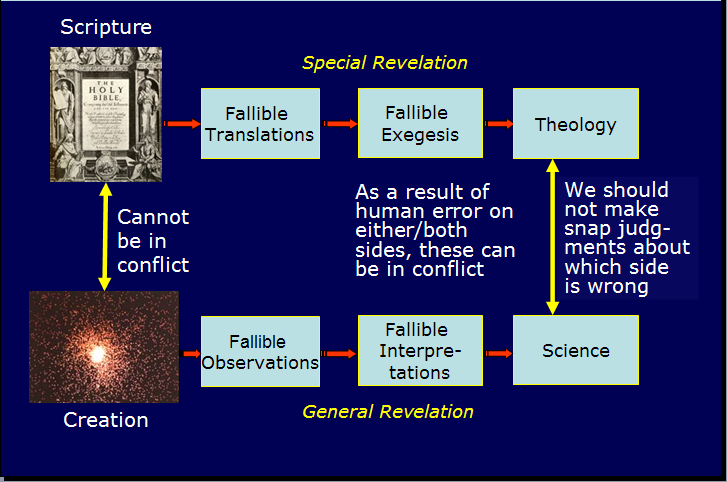
22 SAT “like” because, alas, these venerable constructs have been removed from the SAT.
Subscribe to:
Posts (Atom)